Las Vegas Casino Self-Exclusion
Deposit limits, reality checks, time-outs, full self-exclusion and GAMSTOP — what each tool actually does, how fast it takes effect, and what it cannot undo.
Four Tools, Four Different Jobs
Las Vegas Casino runs on the ProgressPlay platform under UK Gambling Commission account 39335, so the responsible-gambling toolkit is not optional or discretionary — it is a licence condition, and it looks broadly the same at every UK-licensed site. Everything below lives in one place: Account → Responsible Gambling.
People tend to reach for the wrong tool. A deposit limit is for the person who wants to keep playing but not overspend. A time-out is for the person who needs a fortnight away. Self-exclusion is for the person who has decided the answer is no for a long stretch. Closing the account is admin, not protection — it stops nothing on its own.
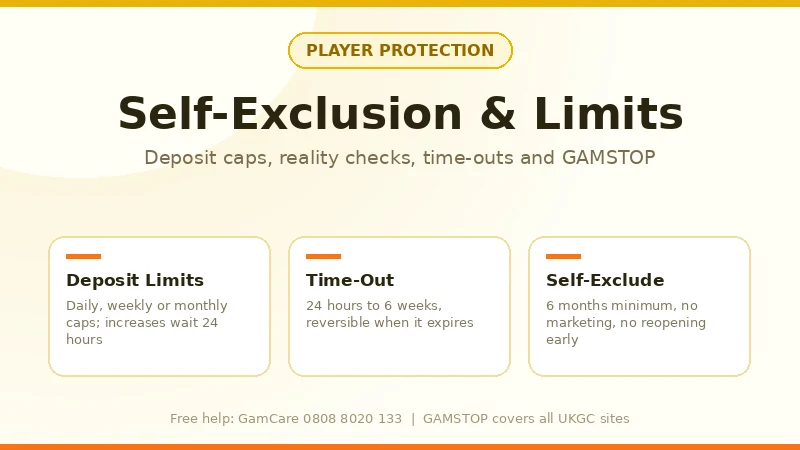
Deposit limit
A daily, weekly or monthly ceiling on what you can pay in. Lowering it is instant; raising it takes 24 hours plus a second confirmation. Best for keeping a normal session normal.
Time-out
A short break of 24 hours to six weeks. The account locks, marketing stops, and it reopens on its own when the clock runs out. No paperwork, no consequences.
Self-exclusion
Six months minimum, up to five years. Cannot be reversed early by you or by support. Marketing must stop entirely and the account stays shut until the period ends.
GAMSTOP
A national scheme, not a casino setting. One registration blocks you at every UKGC-licensed site for six months, one year or five years. This is the strongest option on the page.
Setting a Deposit Limit
You can set a daily, weekly and monthly cap at the same time, and the tightest one wins. The minimum deposit at Las Vegas Casino is £10, so a cap below that effectively stops deposits altogether — some players use exactly that as a soft block.
The asymmetry is the important bit. Cutting a limit applies the moment you save it. Lifting one sits in a 24-hour cooling-off period and then asks you to confirm a second time. That gap exists because the decision to raise a limit is almost never made in the same frame of mind as the decision to set it.
Limits count deposits, not losses. Depositing £50 and winning £200 does not free up more headroom — the ceiling only tracks money going in. If you want a loss cap rather than a deposit cap, the honest answer is that a time-out does the job better.
How to set one
- 1 Log in and open Account.
- 2 Choose Responsible Gambling.
- 3 Select Deposit Limits and pick the period.
- 4 Enter the amount in GBP and save.
- 5 A reduction is live immediately; an increase waits 24 hours.
Menu names can shift slightly between platform releases. If you cannot find it, live chat can apply a limit for you.
Limit Planner
Work out a monthly ceiling from what you can genuinely afford to lose, then check what that means per session. Nothing you type here is sent anywhere — it runs in your browser.
Monthly limit
£80
Weekly limit
£20
Per session
£10
Suggested stake
£0.10
The stake figure assumes roughly 96% RTP and treats your session budget as the amount you expect to lose over that many spins. It is a planning aid, not a prediction — real results swing hard in both directions.
Taking a Time-Out
A time-out is the most underused tool on the list, probably because it sounds trivial next to self-exclusion. It is not. UK operators offer periods from 24 hours to six weeks, and while it runs the account is genuinely locked — you cannot deposit, cannot bet, and cannot talk your way past it with support.
What it does not do: cancel a pending withdrawal, or delete your account. Any balance stays where it is and is still yours. Marketing has to stop for the duration under the UKGC's licence conditions, so the promotional emails go quiet too.
When it expires, the account reopens by itself. That automatic return is the honest weakness of a time-out — there is no friction on the way back. If you suspect that matters for you, self-exclusion is the tool you actually want, because getting back in is deliberately hard.
| Time-out | Self-exclusion | GAMSTOP | |
|---|---|---|---|
| Shortest period | 24 hours | 6 months | 6 months |
| Longest period | 6 weeks | 5 years | 5 years |
| Covers | This site | This site | Every UKGC site |
| Can be reversed early | No | No | No |
| Reopens automatically | Yes | No — needs opt-in | No — needs opt-in |
| Marketing stops | Yes | Yes | Yes |
Self-Excluding, and What GAMSTOP Adds
Self-exclusion at Las Vegas Casino runs for a minimum of six months and can be set up to five years. Once it is confirmed, nobody can lift it early — not you on a bad night, not live chat, not a manager. That is the entire point of the mechanism, and the UKGC requires it to work that way.
When the period expires the account does not simply spring back to life. There is a 24-hour cooling-off window and then a positive opt-in: you have to contact the operator and ask to resume. If you never do, the account stays closed indefinitely.
The catch with site-level exclusion is obvious: it covers one brand. Las Vegas Casino runs on the ProgressPlay platform, which powers a large number of other UK casino brands, and excluding here does not shut those. If the goal is to stop gambling rather than to stop gambling here, GAMSTOP is the tool that matches the goal.
GAMSTOP is the national self-exclusion scheme. Registration is free, takes a few minutes, and every operator holding a UK Gambling Commission remote licence is legally required to integrate with it. One form blocks you at all of them — including this one, under account 39335. Add Gamban on your phone and laptop and you have also removed the offshore sites GAMSTOP cannot reach.
What happens to your money
- Real-money balance is returned to you in GBP.
- Active bonus funds and unwagered free spins are forfeited.
- Pending withdrawals still complete — the block does not seize them.
- Verification may need finishing before the payout is released, so upload documents before you exclude if you can.
Closing the Account (and Why It Is Not Protection)
Closing an account is an administrative request. Live chat can do it, usually within a working day, and any balance is withdrawn first. What it does not do is stop you signing up again ten minutes later with the same details — there is no lock behind it.
If the reason for closing is that gambling has stopped being fun, ask for self-exclusion instead. It is the same conversation with support, it takes the same amount of time, and it is the version that actually holds. Operators are required to offer it, and asking for it is not treated as unusual.
One more thing worth doing on the way out: remove your stored card and wallet details from the cashier. Withdrawals still route to a method on file, but a saved card sitting one tap away is a friction remover you do not need.
What players tell us
"Set the monthly deposit limit at £60 and forgot about it. Two months later I tried to bump it up on a Friday night and the 24-hour wait killed the impulse. That delay is the whole product."
— Dan R., Leeds · 12 July 2026
"Asked live chat for a six-week time-out and it was applied while I was still typing. No upsell, no 'are you sure you don't want a bonus instead'. Credit where it's due."
— Priya S., Birmingham · 3 August 2026
"Closed the account and then realised that did nothing. Went back and did GAMSTOP properly. Should have started there."
— Mark T., Glasgow · 21 August 2026
Free Help in the UK
All of these are free, independent of any casino, and available whether or not you have excluded anywhere.
GamCare
National Gambling Helpline, free on 0808 8020 133, 24/7, plus live chat and treatment referrals.
BeGambleAware
Self-assessment tools, guidance for friends and family, and a directory of local support.
GAMSTOP
One registration excludes you from every UK-licensed gambling site for 6 months, 1 year or 5 years.
Gambling Commission
The regulator. Check any operator's licence on the public register, or escalate a complaint.
Blocking software: banks including Monzo, Starling, Lloyds, Barclays, NatWest and Halifax all offer a free gambling block in-app that refuses card payments coded as betting transactions. It is a good second layer on top of GAMSTOP — see our page on MCC 7995 for how those blocks work.
Common Questions
How do I self-exclude from Las Vegas Casino?
Account → Responsible Gambling → Self-Exclusion. Pick a period from six months to five years and confirm. The block applies immediately, marketing must stop, and the account cannot be reopened before the period ends.
What is the difference between a time-out and self-exclusion?
A time-out is 24 hours to six weeks and reopens by itself. Self-exclusion is six months minimum, cannot be lifted early, and needs a cooling-off period plus a positive opt-in before play can resume.
Does GAMSTOP cover Las Vegas Casino?
Yes. Every operator with a UKGC remote licence must integrate with GAMSTOP, and this casino holds account 39335. Registering blocks you across all UK-licensed sites at once, not just this one.
How quickly does a deposit limit take effect?
A reduction is instant. An increase waits out a 24-hour cooling-off period and then needs a second confirmation from you, so a limit set calmly cannot be undone impulsively.
Can I get my money back after self-excluding?
Yes — any real-money balance is returned. Bonus funds and unwagered spins are forfeited, which is standard across UK operators. You may need to finish verification before the withdrawal is released.
Where can I get free help in the UK?
GamCare's National Gambling Helpline is free on 0808 8020 133, 24 hours a day. BeGambleAware has guidance and a treatment directory, GAMSTOP handles multi-operator exclusion, and Gamban blocks gambling sites on your own devices.

Written and fact-checked by Emma Williams, Casino Review Lead
Published · Last checked