Casino Licensing Explained
What a UK Gambling Commission account number is, why one licence can carry fifty brands, and how to check any casino on the public register before you deposit a pound.
Four Things People Get Wrong
Myth
"A licence badge in the footer means it's licensed"
A badge is an image. Anyone can paste one. The only thing that counts is the account number resolving to an active entry on the Commission's own register, with the domain you are looking at listed on it.
Myth
"Sharing a licence with other brands is dodgy"
It is the standard structure of the UK market. A white-label operator carries the licence, the compliance function and the payments; the brands are front ends. What matters is whether the trading name is registered, not whether it is alone.
Myth
"A Malta or Curaçao licence protects me here"
Not as a UK customer. Those licences govern business in other markets. If a site takes UK sign-ups on an offshore licence alone, it is operating outside the UK regime and you have no UKGC route to complain.
Myth
"Licensed means the games are beatable"
Licensing guarantees the RNG is tested and the advertised RTP is real. It does not change the fact that the RTP is below 100%. Regulation makes the maths honest; it does not make it favourable.
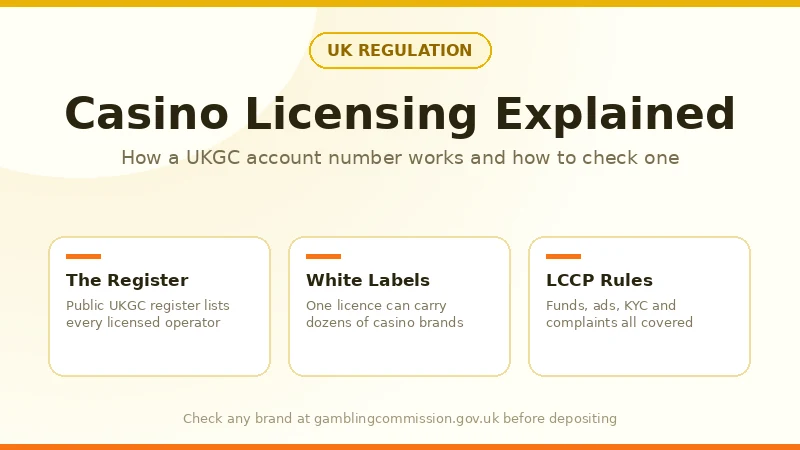
The Definition, Without the Marketing
A UK remote casino licence is permission, granted by the Gambling Commission under the Gambling Act 2005, for a named company to offer gambling to people in Great Britain. It is issued to a legal entity — not to a website, not to a brand, and not to a logo.
That entity gets an account number. Las Vegas Casino operates under account 39335, held by ProgressPlay Limited, a Maltese company. The brand also references a Malta Gaming Authority licence, MGA/B2C/231/2012, which governs the operator's business in other markets. For a player in Britain, the UK account number is the one that carries weight.
Attached to that licence are the Licence Conditions and Codes of Practice — the LCCP. This is the rulebook, and it is considerably more demanding than most players assume. It sets out how customer funds must be held and disclosed, what verification has to happen before a customer can deposit, which responsible-gambling tools must exist, how marketing may be worded, how complaints must be handled, and the requirement to connect to GAMSTOP.
Two structural details explain most of the confusion around brand names. First, one licensee can register many trading names, which is why a single account number turns up dozens of casinos. Second, the white-label model means the company you are actually contracting with is often not the company whose name is on the logo — it is the licensee. Both facts are public, and both live on the same register entry.
What the Licence Buys You
Tested games
RNGs are independently tested and published RTPs have to match what the game actually does. A studio cannot quietly ship a lower-return build to one operator without it being declared.
Stated fund protection
Operators must disclose how customer money is held and what happens to it if the business fails. The rating is published — it is not always the highest tier, and it is worth reading.
Age and ID checks
Verification happens before you can deposit, not after you try to withdraw. That is a licence condition, and it is why KYC arrives early at UK sites.
Mandatory safer-gambling tools
Deposit limits, reality checks, time-outs, self-exclusion and GAMSTOP integration are all required — see our limits page.
Free dispute resolution
If the operator's complaints process fails you, an approved ADR body reviews the case at no cost to you. Unlicensed sites offer nothing comparable.
Advertising rules
Bonus terms must be shown clearly, "free" must actually be free, and marketing must stop entirely once a customer self-excludes.
What it does not buy you: a guarantee of winning, immunity from account restrictions, or a promise that every dispute goes your way. Operators can and do close accounts within their terms. Licensing is a floor on conduct, not a warranty on outcome.
Worked Example: What RTP Regulation Is Worth
Licensing forces the advertised RTP to be the real one. Move the sliders to see what that honesty is worth over a realistic number of spins — and what a couple of percentage points costs when nobody is checking.
Total staked
£1,000
Expected loss at that RTP
£40
Extra loss if RTP were 2 pts lower
£20
Expected values over a long run. A single session will land nowhere near these figures in either direction — that is volatility, not a flaw in the arithmetic.
Our Check: What We Verified and When
Everything on this page about Las Vegas Casino comes from two places: the operator's own published terms, and the Gambling Commission's public register. Where those two disagree, we say so rather than picking the flattering one.
The check itself takes about a minute and you should do it yourself rather than trust us. Open the Commission's register, search either the brand name or the account number from the site footer, and read three lines: is the status active, is the trading name listed, and is the domain listed. Three yeses and the site is what it claims to be.
One caveat we apply consistently: a licence number found on a comparison site or forum is not evidence. Numbers get transcribed wrong and brands change hands. The register is the source; anything else is a lead.
Verified for this page
- Licensee: ProgressPlay Limited — the entity, not the brand.
- UKGC account: 39335, as published in the operator's own footer and terms.
- Additional licence: MGA/B2C/231/2012 — relevant outside the UK, not a UK credential.
- Currency: GBP only for UK accounts. No crypto tier.
- Not verified: the full list of sister brands under the same account. We do not publish a sister-site list we cannot evidence line by line.
Last register check: 19 October 2026.
What Has Changed in the Last Year
Online slot stake limits
Statutory caps on online slot stakes now apply, set lower for younger adults than for the general adult population. If your maximum bet looks smaller than it used to, this is why — it is regulation, not the operator.
Financial risk assessments
Frictionless affordability checks have moved from pilot into wider use. Most customers never notice one; a minority get asked for evidence of means at higher spend levels.
The statutory levy
Operator contributions to research, prevention and treatment moved from a voluntary arrangement to a mandatory levy collected by the Commission. It does not change anything you see on screen, but it changes how treatment is funded.
Tighter bonus rules
Restrictions on how promotional offers can be constructed and advertised have pushed UK welcome bonuses smaller and simpler. The 100% up to £25 with 10x wagering you see here is characteristic of the post-reform market — modest headline, unusually low wagering.
Licensing FAQ
What is a UKGC account number?
The reference the Gambling Commission gives a licensed operator — the only identifier worth checking. Las Vegas Casino sits under account 39335, held by ProgressPlay Limited. Searching it on the public register returns the licensee, its status and every registered trading name.
Can one licence cover several brands?
Yes, and it is normal. A white-label operator holds the licence and runs the platform, payments and compliance while dozens of branded front ends trade under it. Every trading name must appear on the licensee's register entry.
How do I check whether a casino is licensed?
Search the brand or account number on the Commission's public register and confirm three things: status is active, the trading name matches, and the domain is listed. If the brand is not there, it is not UK-licensed.
Does a Malta licence mean anything for a UK player?
Not for your protection here. An MGA licence governs business elsewhere; UK players are covered by the UK licence and the LCCP. A site advertising only Malta or Curaçao while taking UK sign-ups is a warning sign, not a credential.
What does the UK licence actually guarantee?
Tested RNGs, honest published RTPs, age and identity verification, mandatory safer-gambling tools, GAMSTOP integration, a stated customer-funds policy, advertising rules and free dispute resolution. Not that you will win, and not that every dispute goes your way.
What happens if an operator breaks the rules?
The Commission can warn, impose conditions, levy a financial penalty or regulatory settlement, suspend the licence or revoke it outright. Enforcement actions are published, so a brand's compliance record is public reading.

Written and fact-checked by Emma Williams, Casino Review Lead
Published · Last checked